
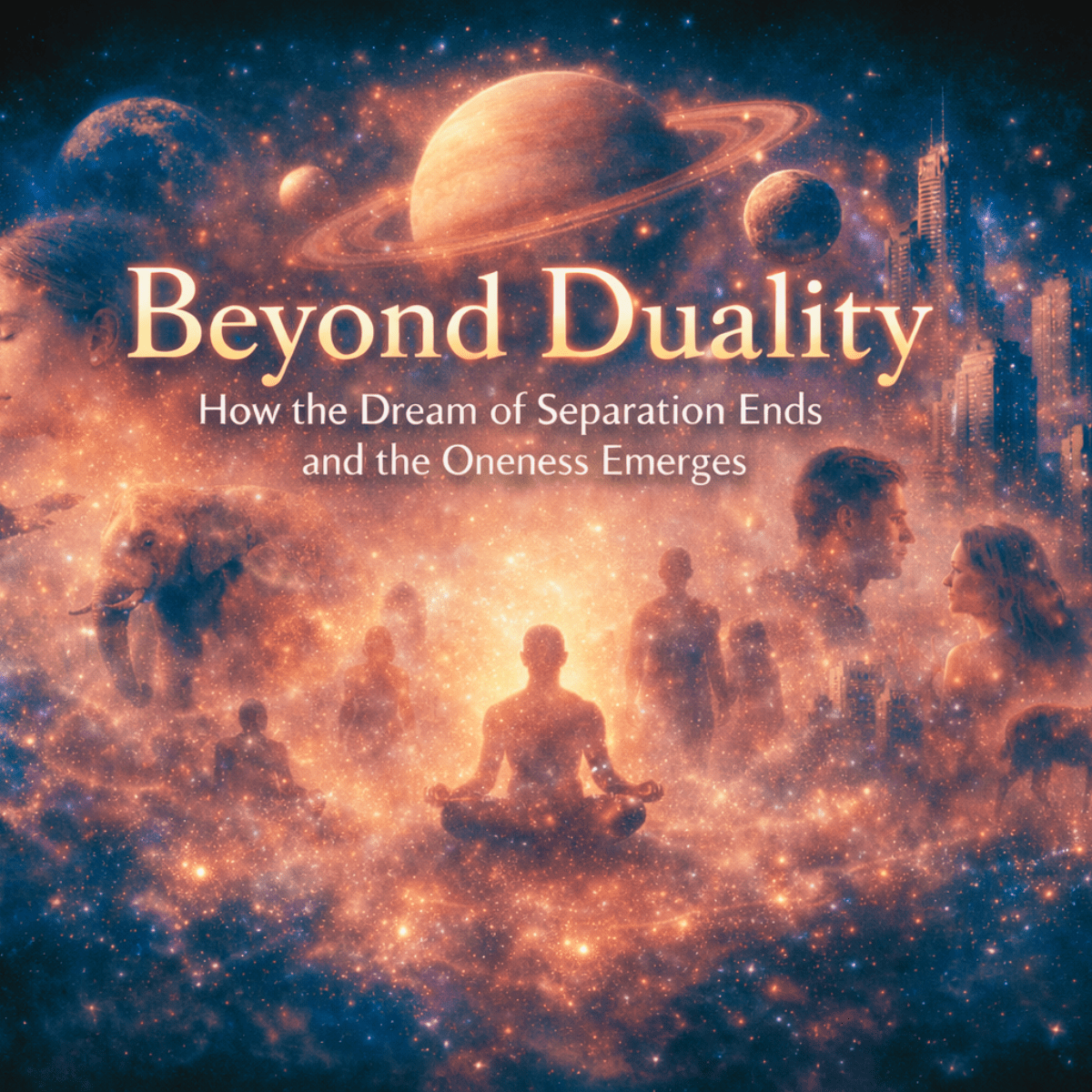
There is a subtle assumption woven into the fabric of the perceptive life experience, so constant, so unquestioned, that it feels like truth itself:
That there is a “you” here . . . and a “world” out there.
A thinker . . . and something to think about.
An observer . . . and something observed.
A self . . . and an other.
This division appears self-evident. It feels stable. It feels real.
But it is neither fundamental nor original.
It is constructed.
The First Split: “I” and “Other”
Before language, before concept, before identity, there is awareness.
Not “your” awareness. Not “my” awareness.
Just awareness.
Yet within the unfolding of experience, a movement occurs. Sensation organizes. Memory stabilizes. Patterns repeat. And from this repetition, a center is inferred:
“I am this.”
That statement is not discovered; it is assembled.
Neuroscience echoes this quietly. The brain does not reveal a world; it predicts one. Perception is not passive reception; it is active construction. As cognitive scientist Anil Seth describes it, we are living within a “controlled hallucination,” where the mind continuously generates models and updates them based on incoming signals.
The “other,” then, is not encountered as an independent entity; it is interpreted as such.
A face appears. A voice is heard. A presence is felt.
But what is known of it arises within the same field that knows the thought “this is someone else.”
The division is conceptual.
The experience is unified.
The Second Split: “Mind” and “Body”
Another layer of separation appears more convincing:
“I have a body.”
“My mind is inside it.”
But examine this closely.
The body, its sensations, its boundaries, and its movements are known through perception. Sensory signals are translated into experience. The feeling of weight, of tension, of breath, these are appearances within awareness.
Even the image of the body is constructed internally. You do not see your body directly; you perceive a representation.
Modern neuroscience aligns here as well. Predictive models of the body (interoception and proprioception) are continuously generated and updated. What feels like a solid, objective body is, in fact, a stabilized perceptual model.
The body is not outside awareness.
It is within it.
Thus, the division between “mind” and “body” dissolves. Both are movements within the same field of knowing.
The Third Split: “Self” and “World”
The final and most persistent illusion:
“That world exists independently of awareness.”
It feels obvious. The room seems external. The sky seems distant. Objects appear to exist whether attended to or not.
But what is ever known of “world” arrives only as experience, color, shape, sound, texture, thought.
There is no access to anything beyond this presentation.
Physicist Albert Einstein once remarked, “Reality is merely an illusion, albeit a persistent one.” Not as dismissal, but as recognition: what appears solid is deeply dependent on observation, interpretation, and frame.
The “world” is not encountered outside awareness.
It is encountered as awareness taking form.
The Collapse of Division
When these splits are seen clearly, not philosophically, but directly, the structure of separation begins to loosen.
“I” is no longer a fixed center, but a pattern of identification. “Other” is no longer truly separate, but a differentiated appearance. “Body” and “world” are no longer outside, but within the same field.
What remains is not a new belief, but a recognition:
There has never been division.
Only differentiation within unity.
Beyond “One”
Even the word “One” carries a subtle distortion.
To say “one” implies contrast, two, many, division counted, and then resolved.
But what is being pointed to here is before the number.
It is not one as opposed to many.
It is not unity as opposed to multiplicity.
It is that within which both unity and multiplicity appear.
“All is all.”
Not as a statement, but as the absence of division itself.
The End of the Dream of Separation
The dream of separation does not end through effort. It does not end through belief, philosophy, or force.
It ends through seeing.
Seeing that every “other” is known within the same field that knows “self.”
Seeing that every boundary is perceived, not absolute.
Seeing that what appears as many is not divided in its source.
And in that seeing, something relaxes.
The compulsion to defend a separate self softens.
The need to grasp or resist the “outside world” loosens.
The search for completion in what appears begins to dissolve.
Because what was sought . . . was never elsewhere.
What Remains
Experience continues.
Forms arise. Thoughts move. Interactions unfold.
But the illusion that these are happening between separate entities fades.
There is no longer a center struggling against an external world.
There is only the seamless unfolding of perception within the same indivisible field.
Not one.
Not many.
Not divided.
Just this, as it is, without separation.
And in that, the quiet recognition:
There was never an “other” to begin with.